
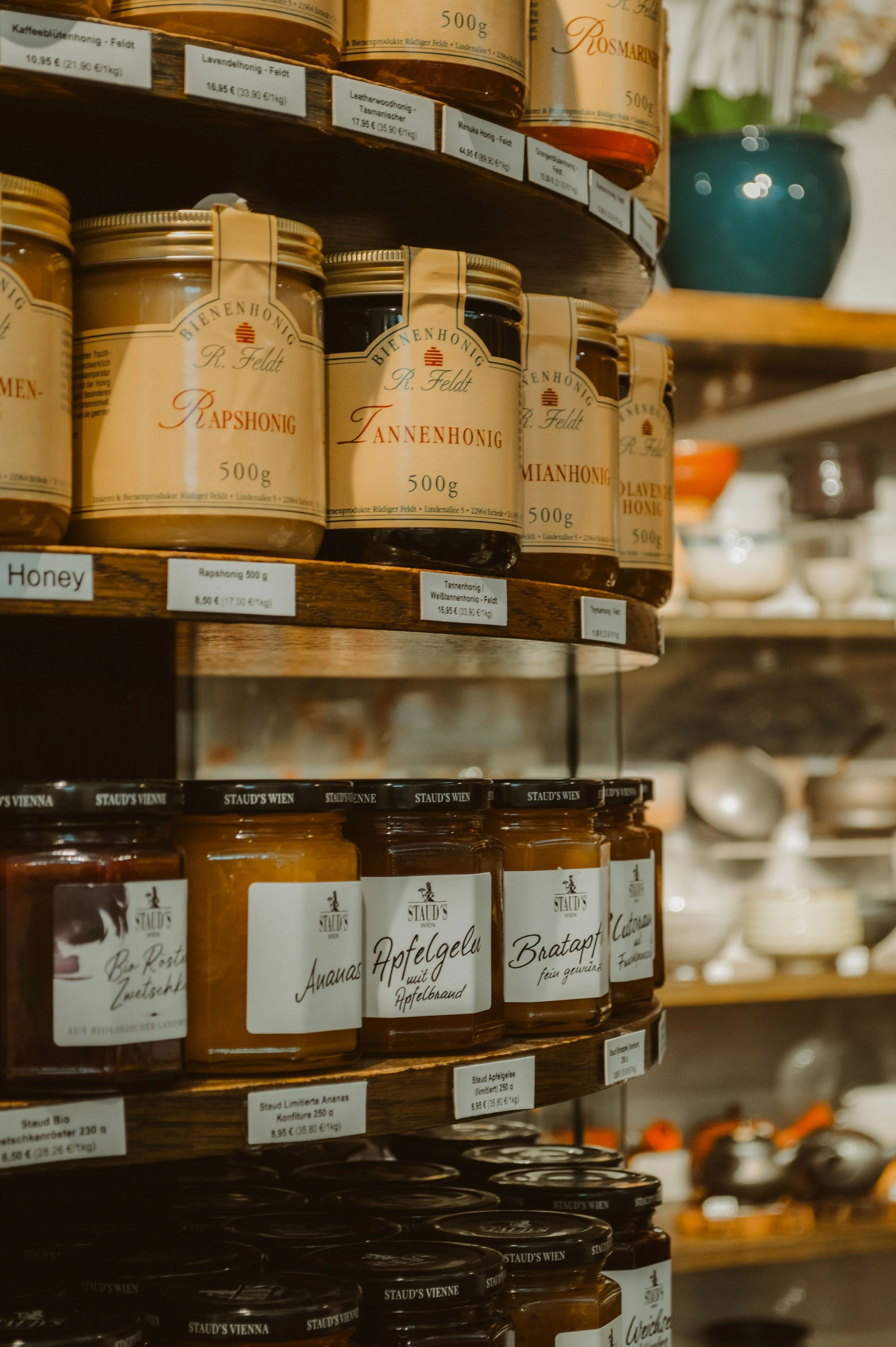
Walk down any natural food aisle in 2026 and count the times you see these words:
Artisan. Authentic. Clean. Natural. Real. Pure. Honest. Simple. Craft. Traditional. Wholesome. Farmer. Ancient. Heritage. Premium. Thoughtful.
Now ask yourself: do any of them mean anything to you anymore?
If you're a typical North American shopper, the answer is probably no. And if you're a food brand still leading with these words, you may be actively eroding the trust you're trying to build.
There's a quiet revolution underway in food and beverage packaging. The brands at the front of it are removing claims, not adding them. Reducing copy, not expanding it. Letting their product's specificity speak instead of reaching for the same adjectives every competitor is using.
This is the "quiet label" strategy. And understanding it might be the most important packaging reframe you encounter this year.
How We Got Here: The Credibility Collapse of Food Label Language
The death of food label language credibility happened slowly, then all at once.
It started in the 1990s with "fat-free", a claim so broadly applied to foods that were simultaneously loaded with sugar that the FDA eventually had to restrict its use. Then came "natural," which the FDA still has no formal definition for, allowing it to appear on products containing high-fructose corn syrup, artificial colours, and GMO ingredients depending on interpretation.
"Organic" remains the exception, it has regulatory definition and meaning. But every word adjacent to it has been progressively hollowed out.
"Artisan" is the word used by both a grandmother making 200 jars a year in her certified kitchen and a facility producing 200,000 units a week. "Craft" is the word on both a micro-brewer's first run and a major beer company's flanker brand. "Heritage" is the word on a line of products that launched in 2019. "Ancient grains" appears on everything from genuinely traditional preparations to products where the ancient grain in question represents 3% of total ingredients.
Consumers noticed. They have been noticing for a long time.
What the Research Shows
Consumers in 2026 are asking tougher questions about what brands actually deliver. More than 90% of Gen Z and Gen X consumers report being highly attuned to economic pressures and global news. They bring that same critical vigilance to the grocery shelf.
The consumer who emerged from years of inflation, tariff anxiety, and a constant stream of "greenwashing" and "authenticity-washing" exposés is not the consumer of 2015. They are faster to skepticism, slower to trust, and completely immune to claims they've seen too many times.
Research into consumer attitudes toward food labels consistently surfaces the same pattern: as a category's use of a particular claim increases, consumer trust in that claim decreases, often to the point where the presence of the claim actively signals lower credibility rather than higher.
In simpler terms: when every brand is "artisan," artisan means nothing. And when artisan means nothing, putting it on your label is not neutral, it's a signal that your brand is the kind of brand that uses empty words.
That signal is hurting more brands than it's helping.
What "Quiet Label" Actually Means
The quiet label approach is not minimalism for aesthetic reasons. It's a strategic decision about what builds consumer trust most effectively.
At its core, the quiet label philosophy holds that: Specific, verifiable, concrete information builds trust. Generic, aspirational, qualitative claims destroy it. And in a world where every surface is covered in claims, silence, or specificity, speaks loudest.
The quiet label move takes different forms in different categories. But the principle is consistent: replace what you're claiming with what you're showing.
The Shift from Claim to Evidence
Old approach: "Our authentic, artisanal hot sauce is made with natural, farm-fresh ingredients and crafted with passion for over 30 years."
Quiet label approach: "Fermented for 30 days. Three peppers. One facility. Family-owned since 1994."
The second version contains no claims. It contains facts. And facts specific, verifiable, concrete facts, do the emotional work that adjectives used to do, except they do it without triggering the consumer's well-calibrated skepticism alarm.
Every element is either verifiable or immediately credible:
"Fermented for 30 days" is a process claim with implied craft and quality
"Three peppers" communicates simplicity and ingredient focus
"One facility" suggests scale, commitment, consistency
"Family-owned since 1994" is verifiable and carries its own emotional resonance without needing to claim "authentic" or "heritage"
The brand that writes the first version is claiming authenticity. The brand that writes the second version is demonstrating it.
The Hierarchy of Credibility
Not all information carries equal weight with skeptical consumers. Here's how it actually stacks up:
High credibility:
Specific numbers (dates, percentages, quantities, locations, certifications)
Named ingredients, named farms, named regions
Third-party verification (certifications, lab results, industry recognition)
Founder and maker identity (real people, not concepts)
Process description with specific technical detail
What the product doesn't contain, but only when meaningful and verifiable
Medium credibility:
Category-specific claims with regulatory backing (Certified Organic, Non-GMO Project Verified)
Geographic origin with legal protection (PDO/PGI designations)
Specific nutritional claims backed by nutrition panel
Customer volume and reach claims ("trusted by 50,000 families")
Low credibility (and falling):
"Natural"
"Artisan" / "Artisanal"
"Craft" / "Crafted"
"Authentic"
"Premium"
"Heritage"
"Pure"
"Wholesome"
"Clean"
"Simple" (in most contexts)
"Family recipe" without supporting specifics
The quiet label strategy systematically moves copy up this hierarchy, trading low-credibility claims for high-credibility specifics.
Heritage Brands: The Quiet Label Is Your Superpower
For heritage and ethnic food brands, this strategy isn't just smart. It's a return to what actually made heritage food brands compelling in the first place.
Nobody fell in love with a grandmother's recipe because it was "artisanal." They fell in love with it because of the specific ingredients, the specific technique, the specific person, the specific kitchen, the specific occasion. The specificity was the authenticity.
When heritage brands layer on generic language to appeal to Western consumers, they frequently sand away exactly what makes them interesting. They reach for words like "authentic" and "traditional" because those words signal the right values, but they underestimate how much more powerful specific truth is than aspirational vocabulary.
The Specificity That Heritage Brands Have and Nobody Else Can Claim
Heritage food brands possess categories of specific information that no competitor can replicate:
Geographic specificity: Not just "Caribbean pepper sauce", say "Trinidad Scorpion and Congo pepper sauce, made in Port of Spain since 1987." instead. Nobody else can say that. And that specific truth, placed on a label without fanfare, is worth more than a hundred "authentic" claims.
Process specificity: Not "traditionally fermented", say "stone-ground, naturally fermented at ambient temperature for a minimum of six weeks." instead. The detail communicates the value proposition without needing to claim premium or artisanal.
Ingredient specificity: Not "natural spices", say "sun-dried Guajillo, Ancho, and Pasilla chiles from Oaxaca." instead. The specificity educates and differentiates simultaneously. It's a flavour story, a geography lesson, and a quality signal in six words.
Person specificity: Not "family recipe", say "Developed by Maria Gonzalez in her Guadalajara kitchen in 1962. Her daughter scaled it for retail in 1991. Her granddaughter ships it to you today." instead. Three generations in two sentences. No adjective required.
These are stories that large competitors with anonymous supply chains and homogenized formulations absolutely cannot tell. Quiet label strategy for heritage brands isn't about saying less, it's about saying the right specific things instead of the wrong generic ones.
Big Brand Application: When "Less" Is a Premium Move
The quiet label strategy doesn't belong only to small heritage producers. Some of the most effective quiet label executions in recent years have come from established brands deliberately stripping away language.
Why Established Brands Are Over-Claiming
Large CPG brands tend to accumulate claims the way attics accumulate objects, new ones get added with each product refresh, few get removed, and eventually the label is carrying ten years of marketing strategy all at once.
The result is packaging that reads like a negotiation. "Natural. No artificial colours. No artificial flavours. No preservatives. Sustainably sourced. Non-GMO. Gluten-free. Small batch quality. Big brand trust." Every statement is trying to address a different consumer objection. The cumulative effect is that the consumer feels talked at rather than spoken to, and skepticism rises with every added claim.
This accumulation is one of the most common and most expensive mistakes in food brand design, and it's almost invisible to the teams who build it because each claim was added with individually sound reasoning.
The quiet label audit question: If this claim were removed, would our product sell less? If the honest answer is "no", if the claim is defensive cover rather than genuine value communication, it should be removed.
The "Flagship Ingredient" Strategy
One powerful quiet label technique for established brands: identify the single most compelling, credible, and differentiated thing about your product, and let that ingredient or attribute carry the front of pack.
Cholula's front of pack is: the name, a flavor descriptor, and the distinctive wood cap. That's it. No "artisan," no "traditional," no "natural." The brand identity does the work.
Maldon Sea Salt. The name and the origin. No descriptors.
Balsamic Vinegar of Modena with PGI certification. The certification does all the claim work. No additional adjectives needed.
In each case, the product's genuine specific identity communicates more effectively than any adjective could. The quiet label reveal is always the same: when the specific truth is compelling enough, claims are not just unnecessary, they're actively weakening.
Designing the Quiet Label
If the strategy is clear, the execution is nuanced. Removing claims from a label without a comprehensive design rethink often produces something that looks empty rather than confident.
The quiet label isn't a blank label. It's a precisely designed label where every element is pulling weight.
Hierarchy Becomes Everything
When you remove qualitative language, the hierarchy of what remains becomes your primary communication tool. The eye needs somewhere to land, a sequence to follow, and a reason to engage.
A quiet label typically features:
Product identity: What this is, stated with maximum precision. Not "artisanal hot sauce," but "Fermented Scotch Bonnet Pepper Sauce."
The specific differentiator: The one thing that makes this product worth choosing. One line, maximum two.
Brand identity: Who made it, with enough specificity to be human and credible.
Supporting specifics: On secondary panels: ingredient list, origin story, process notes, producer information.
Typography as Trust Signal
When you're not filling space with claims, your typography has to do more communicative work. A quiet label executed with weak, unconfident typography reads as an unfinished label, not a confident brand.
The typography choices for quiet label execution should convey:
Precision: Clean serifs or well-designed sans-serifs that signal attention to detail
Permanence: Typefaces with some history and weight, not trend-chasing novelty
Legibility: Everything readable at shelf distance, because the specific information you're communicating is worth reading
There's a meaningful difference between minimalism that communicates confidence (look at any premium olive oil from a serious producer) and minimalism that communicates incompleteness (look at an early-stage startup that hasn't finished their label).
The Back Panel as Payoff
The quiet label strategy creates a reader's reward opportunity on the back panel. The front makes a restrained, specific claim. The back panel delivers the full, specific story for the consumer who wants it.
This is where you put:
The origin story with real geographic and personal specificity
Process description with enough technical detail to be credible
Ingredient notes that expand on front-of-pack specifics
Producer identity, real names, real location, real year
A QR code to extended content, video, or farm/facility information
The consumer who picks up the product based on the confident quiet front panel and turns it over to read the back panel is a high-intent buyer. Give them a story worth reading.
White Space Is Not Wasted Space
This is the design principle that most brands executing quiet label strategy struggle with most.
Empty space on packaging does not signal cheap production or missing information. In the context of a carefully executed quiet label, it signals confidence. It says: we have nothing to hide behind, and we don't need to fill your field of vision with defensive claims.
Most food packaging is designed to fill every available centimetre of surface area. This creates visual noise that consumers have learned to scan past. A package with intentional white space stops the eye, because it breaks the visual pattern of every other product on the shelf.
Premium wine producers understood this 40 years ago. Premium olive oil producers understood it 30 years ago. Premium food brands are only now catching up.
When the Quiet Label Strategy Is Wrong
This approach is not appropriate for every brand or every product. A few honest counterpoints:
New category products that require explanation: If your product is genuinely unfamiliar (an Ethiopian teff flatbread, a West African dawadawa seasoning, a Filipino vinegar-based cooking condiment etc.) you cannot afford to say little on your packaging. Consumers need enough education to feel confident picking it up. The quiet label principle still applies (specificity over claims) but you need more words, not fewer, in the service of that education.
Value-tier products in commodity categories: If you're competing primarily on price in a category where consumers are comparing shelf prices, the quiet label approach may not serve you. This strategy works best where there's genuine differentiation worth communicating and a consumer willing to spend more than the minimum.
Regulatory-driven minimum disclosure: Some label real estate is occupied by law, not by choice. Nutrition panels, allergen declarations, bilingual requirements in Canada, these are non-negotiable. The quiet label strategy applies to the marketing and brand communication elements, not to compliance requirements.
The Bottom Line: What Gets Heard in a Room Full of Shouting
The food aisle in 2026 is loud. Every brand is claiming to be the most natural, most authentic, most artisanal, most pure, most honest version of their product category.
In that room, the brand that speaks quietly and specifically is the one consumers hear.
The quiet label revolution isn't minimalism as aesthetic preference. It's a strategic response to a specific market condition: claim inflation has devalued adjectives. The currency of consumer trust is now evidence, specificity, and the courage to say less because what you're saying is actually true.
Your product has a specific story. A specific person made it. Specific ingredients went into it. A specific process was applied with specific intentions.
Tell that story. Specifically. Without the adjectives.
See what happens.
At Eye Candy Design, we've been advocating for specificity over claims long before it became a trend. If your current packaging is carrying words that have stopped earning their space, we can help you identify what actually matters, and design it so it works harder.
Target Keywords: food label claim fatigue, quiet label packaging strategy, minimalist food packaging design, consumer trust food brands, packaging claim overload, authentic food packaging, clean label vs quiet label, food brand credibility 2026, heritage food packaging specificity, CPG label strategy