
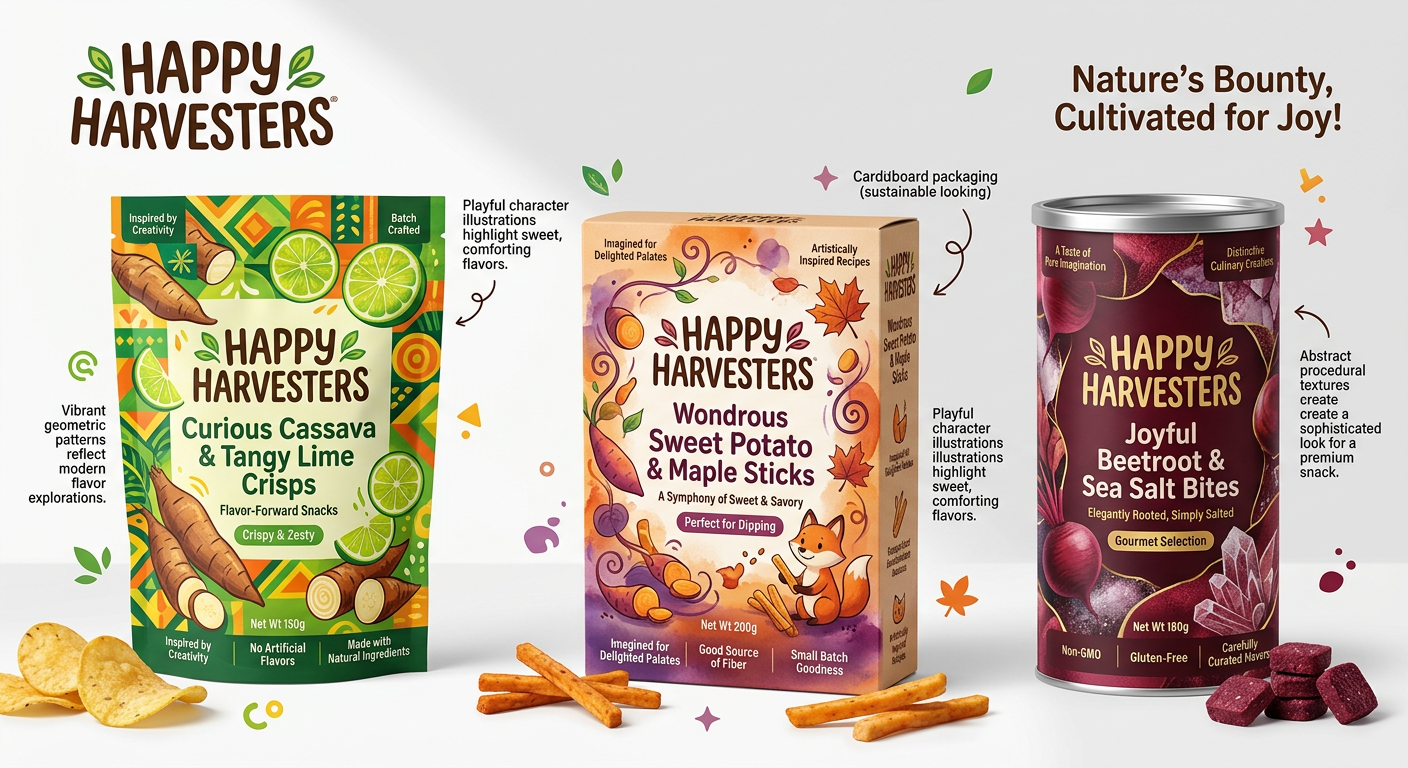
There's a conversation happening in every CPG boardroom right now that nobody's being fully honest about.
Company after company is announcing AI packaging initiatives, AI design tools, AI concept generation. According to McKinsey, more than 80% of packaging leaders said their companies had generative AI initiatives under consideration, in development, or already launched, up from just 30% the year before.
And somewhere, a founder is sitting on their laptop at midnight, running their spice blend concept through Midjourney, looking at four polished AI-generated packaging options, and thinking: maybe I don't need a designer at all.
I need to talk directly to that person.
And I need to talk to the brand manager at a mid-sized food company who just pitched their CMO on an "AI-first packaging workflow" and is now wondering why the retail buyers keep passing on the samples.
AI is genuinely useful for some parts of food brand design. And it is genuinely dangerous for others. Most of the industry conversation right now confuses the two, either breathlessly praising AI as a design revolution or dismissing it entirely.
The truth, as usual, is more complicated and more interesting.
What AI Is Actually Good At in Food and Beverage Packaging
Let's start with honest credit. Used correctly, AI tools deliver real value in the packaging process.
Concept Exploration at Speed
A packaging design process that used to take three weeks to reach a first round of concepts can now reach 20 to 30 rough visual directions in an afternoon using tools like Midjourney or Adobe Firefly. For a team trying to decide between a minimalist and a maximalist direction, or between warm earth tones and a cool clinical palette, this speed is genuinely useful.
The key word is directions. What AI generates well are rough directional concepts, visual hypotheses that allow a brand to quickly gut-check positioning ideas before anyone spends significant time executing them. This is valuable for:
Early-stage founders trying to understand the visual landscape of their category
Brand managers presenting initial options to leadership before commissioning full design work
Designers using AI outputs as springboards for original concepts, and packaging mockups, not finished work
Competitive Shelf Mapping
AI tools are increasingly useful for analyzing visual patterns across existing packaging. Feed a tool 50 images of your competitive set and ask it to identify what's common, and suddenly you have a data-supported answer to the question "what would make us stand out?"
This kind of analytical work is time-consuming for humans and relatively simple for AI. It surfaces patterns in colour frequency, typography conventions, imagery style, and information hierarchy across a category. It won't tell you why those patterns exist or whether breaking them is smart, but it gives you faster raw material to work with.
Packaging Brief Generation
AI can help translate raw brand strategy into more structured creative briefs. Feed it your positioning statement, your target consumer description, your price point, and your category, and it can generate a reasonably useful starting framework. For smaller brands that haven't done extensive brand documentation, this shortcut is real.
The Limits Are Real, Not Theoretical
Here's what the AI enthusiast camp keeps leaving out of the conversation: the gaps aren't minor. They're the most important parts of the job.
Where AI Fails, Specifically in Food and Beverage
Cultural Context: The Problem That Will Haunt Heritage Brands
AI image generation models are trained on vast amounts of visual data. They are exceptionally good at producing outputs that look like the average of everything they've seen. They are exceptionally bad at producing outputs that are culturally specific, contextually appropriate, and representationally accurate.
For a heritage food brand, this is not a minor inconvenience. It is a core threat.
Ask an AI tool to generate packaging for a West African spice brand and watch what it produces. You'll likely get something that hits a few visual tropes, warm ochres, some abstract patterns vaguely inspired by textiles, maybe an illustration that references "Africa" in the same generic way a tourist shop souvenir might.
What you won't get is the specific visual language of Ghanaian kente weaving versus the geometric precision of Nigerian adire. You won't get typography informed by the visual culture of a specific region. You won't get colour relationships that carry cultural meaning. You won't get the appropriate level of reverence or playfulness that a specific food tradition demands.
AI generates what looks plausible. Cultural identity packaging requires what is true.
And the consequences of getting it wrong aren't just aesthetic. A heritage food brand that produces packaging that looks like a caricature of their own culture, generated by AI that has no genuine knowledge of that culture, doesn't just look bad. It erodes the core trust proposition that makes heritage brands valuable in the first place.
One industry practitioner put it plainly: AI-generated product photography is still uncanny enough to feel off at shelf. The same applies, perhaps more powerfully, to cultural illustration and heritage visual identity.
Regulatory Compliance Is Not a Design Feature AI Can Provide
This point deserves to be louder than it usually is.
Food packaging in Canada and the United States is governed by detailed regulatory frameworks. Bilingual labeling requirements in Canada. FDA nutrition panel specifications. CFIA guidelines on origin claims, allergen declarations, and ingredient ordering. Front-of-package nutrition symbol requirements coming in 2026.
AI tools do not know your specific compliance requirements. They will generate compelling-looking label designs that may be entirely non-compliant with Canadian food regulations.
AI-generated trademark or brand-name research should never be trusted, AI hallucinates trademark status confidently and incorrectly. The same principle applies to regulatory compliance. An AI tool might produce a label that looks professional but places the nutrition panel incorrectly, omits mandatory bilingual elements, uses a banned claim, or misses the new front-of-package nutrition symbol requirements.
For a heritage brand launching in Canadian retail, a non-compliant label means your product doesn't make it to shelf. For an established brand, it means expensive reprints and potentially damaged retailer relationships. In both cases, the cost of AI-generated regulatory errors dwarfs whatever time was saved in concept generation.
Print Production: Where AI Concepts Go to Die
Here's a workflow failure happening across the industry right now:
A founder loves an AI-generated concept. The colours look beautiful on screen. The image feels right. They send it to a printer.
What comes back from the printer does not look like what they saw on screen.
AI output is generated for screen display. Food packaging is printed, usually in CMYK process colour, sometimes with Pantone spot colours, on substrates ranging from matte kraft paper to glossy film to clear pouches to glass. Colour management for print production is a specialized technical discipline that has nothing to do with how compelling an AI image looks in a browser.
A working packaging design professional will manage your Pantone selections, verify your CMYK colour builds, account for the substrate's effect on colour, check trapping and bleed requirements, and ensure that what goes to the printer produces something that looks like your brand.
AI shows you what something looks like on screen. Pantone, CMYK, and printed swatches show you what it will look like printed. They are not the same thing. AI cannot bridge that gap.
Strategy Cannot Be Automated
This one is harder to articulate but more important than any technical limitation.
Packaging design, done properly, begins with a strategic question: what does this packaging need to accomplish in the mind of a specific person at a specific moment in a specific retail context?
That question requires understanding your consumer's unspoken anxieties, your category's visual conventions and how to selectively break them, your brand's authentic story and how to compress it into three seconds of shelf interaction, the competitive dynamics of the specific planogram you're trying to enter, and the regulatory and retailer-specific requirements that constrain the design space.
AI has no access to most of this information. It doesn't know what your buyer from Sobeys told you matters. It doesn't know that the product next to yours on shelf has a similar colour palette and you need to differentiate. It doesn't know that your target consumer has been burned by "ethnic food" caricatures before and will walk away from anything that reads as performative. It doesn't know that your glass jar and your pouch variant need to function as a coherent brand system at different price points.
Strategy is the part of the design process that earns its cost most completely. And it is the part most completely outside what current AI tools can provide.
The Honest AI Workflow for 2026
Given all of this, what does a sensible approach to AI in food packaging actually look like?
The workflow that's working for CPG brand teams combines AI's speed with human strategic judgment:
AI-Assisted Concept Exploration: Use AI tools to generate 20-30 rough visual directions. Treat these as rough thumbnails, not concepts. Use them to identify which visual territories feel right for your brand, which feel wrong, and which you haven't considered.
Human Strategic Assessment: A designer with CPG packaging experience reviews the directions, applies category knowledge, identifies regulatory considerations, and develops a shortlist of 3-5 strategic territories worth pursuing. This is the step AI cannot replace.
Human Execution: Actual packaging design is executed by a human designer who understands print production, compliance requirements, and how to build a complete, production-ready file. AI-generated raster output should never go directly to a printer.
Validation: Consumer testing, regulatory review, compliance verification. AI tools should not be used for trademark research or claim validation.
This workflow captures AI's genuine value (speed in early exploration) without trusting it for the functions where it reliably fails (cultural accuracy, regulatory compliance, print production, strategic judgment).
A Word Specifically for Heritage Brand Founders
I want to speak directly to immigrant founders and heritage brand owners who may be considering AI-generated packaging because it seems faster or more affordable than working with a designer.
Your brand's single greatest competitive advantage is its authenticity. The visual language of your packaging is either a carrier of that authenticity, or a betrayal of it.
AI tools trained primarily on Western consumer packaged goods data will produce outputs that look like Western consumer packaged goods. If you're trying to communicate the genuine visual culture of your heritage, to honour your grandmother's recipes, to represent your community with specificity and pride, to tell a story that no competitor can replicate, that is precisely the work AI is least equipped to do.
Heritage branding is not a visual trope to be generated. It's a specific conversation between a brand and a culture, mediated through design choices that require cultural knowledge, aesthetic judgment, and contextual understanding.
The good news: working with a designer who specializes in cultural food brands and who approaches your brief with the curiosity and rigour that authentic representation demands will produce something AI simply cannot. It will be worth more than it costs, because authenticity, real, specific, un-replicable authenticity, is what your market is hungry for.
The risk of using AI to generate a "heritage-looking" package and losing the trust of the very community your brand represents is not a risk worth the cost savings.
What Big Food Companies Are Getting Wrong About AI
For established CPG brands, the risk runs differently.
Many large food companies are using AI primarily as a cost-reduction tool, trying to generate acceptable packaging faster and cheaper by substituting AI for parts of the design process. Maybe some of this substitution is appropriate (rough concept generation). Most of it isn't.
The brands currently leading in category growth aren't cheaper versions of themselves. They're clearer versions of themselves. The 2026 packaging landscape rewards brands with sharp, confident, specific identities, not brands that look like an averaged version of their competitive set.
AI-first workflows tend to produce exactly that averaged output: competent, unremarkable, and indistinguishable from the dozens of competitors whose packaging was generated by the same tools with similar prompts.
The competitive advantage in packaging right now is not speed of execution. It is quality of strategy and depth of brand understanding, the very elements that AI cannot provide and that experienced brand & packaging designers are uniquely positioned to deliver.
The Real Opportunity AI Creates for Brands That Understand This
Here's the counterintuitive conclusion that most of the industry is missing.
AI is making average packaging cheaper and faster to produce. Which means the shelf is about to be flooded with packaging that looks competent and feels generic.
For brands willing to invest in strategic, human-led design, especially for heritage products that require cultural specificity, for launches targeting sophisticated retail buyers who are evaluating dozens of pitches, for product lines where the packaging is the primary brand communication, the gap between your packaging and everyone else's is about to get significantly wider.
AI raises the floor. It doesn't raise the ceiling.
The ceiling (distinctive, authentic, culturally specific, strategically precise, category-disrupting packaging design) is still entirely a human endeavour. And as the floor rises, the ceiling becomes more valuable, not less.
If you're a heritage brand with an authentic story to tell, or a growing CPG company trying to establish genuine category leadership, the brands that lean into human-led design strategy right now are the ones that will be referenced in case studies five years from now.
The question isn't whether AI is useful. It is. The question is whether you understand which parts of your brand's success it can contribute to, and which parts require something AI cannot replicate.
Ready to Stand Out in a Saturated Market ?
If your packaging is carrying your brand's entire story to a consumer in three seconds, you are losing money.
Your story deserves more than a prompt. Let's talk about your branding and packaging strategy!
Keywords: AI food packaging design, artificial intelligence CPG branding, ai generated packaging problems, human vs ai design food brands, packaging design strategy 2026, heritage food branding AI, CPG brand design 2026, food packaging authenticity, AI limitations packaging